最速降下曲線-05 - 高さH,距離Lの場合
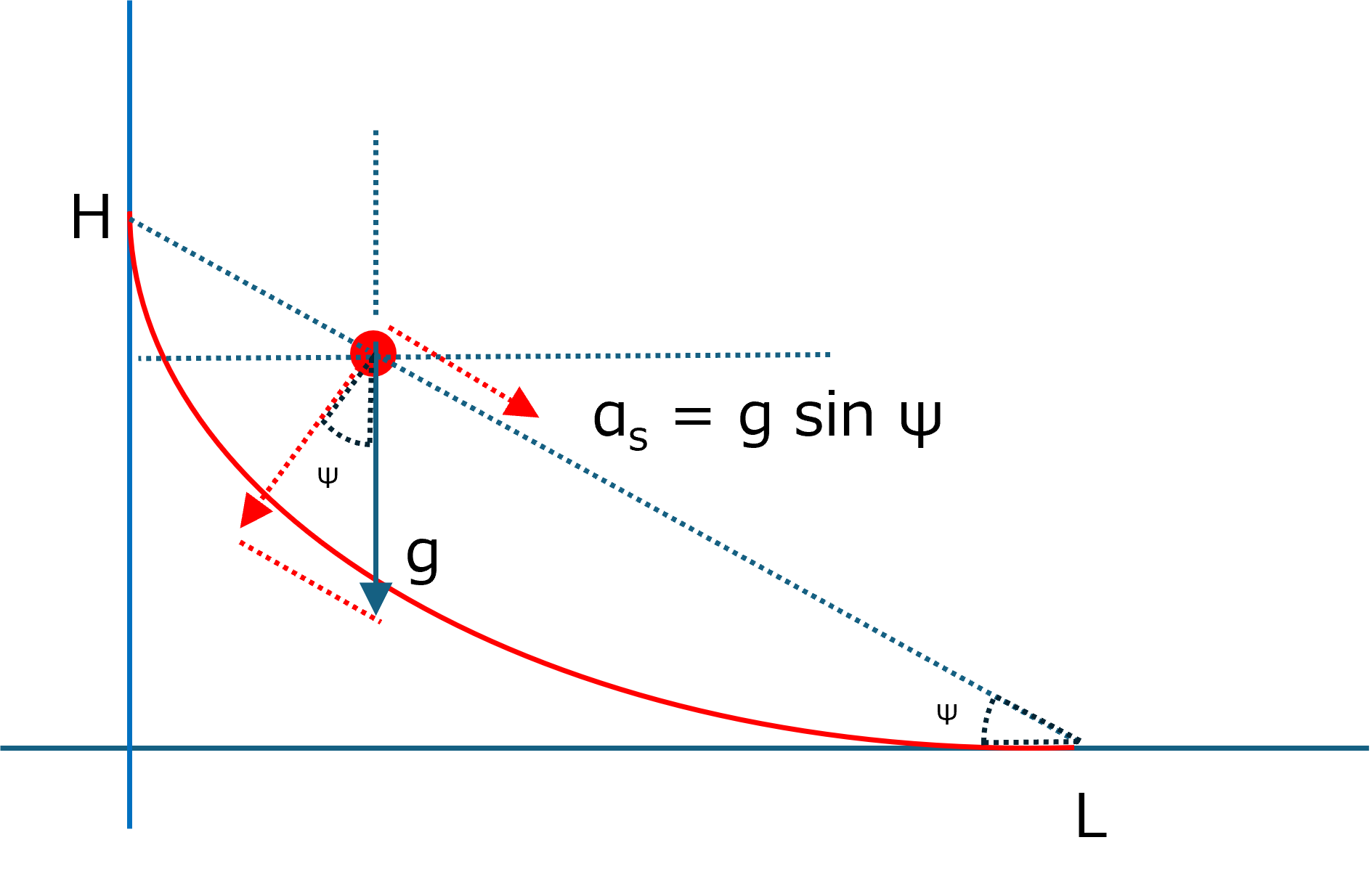
直線状を進む場合を考えていきます.
・高さH,距離Lの場合
$$
{ \Large \displaystyle
\begin{equation}
\begin{split}
tan \ \psi &= \frac{H}{L} \\
\alpha_{s} &= g \ sin \ \psi
\end{split}
\end{equation}
}
$$
斜面方向の速度,変位は,
$$
{ \Large \displaystyle
\begin{equation}
\begin{split}
\alpha_{s} &= g \ sin \ \psi \\
v_s(t) &= \alpha_2 \ t \\
s(t) &= \frac{1}{2} \alpha_s \ t^2 \\
\end{split}
\end{equation}
}
$$
xy方向の変位は,
$$
{ \Large \displaystyle
\begin{equation}
\begin{split}
x_s(t) &= s(t) \ cos \ \psi \\
y_s(t) &= H - s(t) \ sin \ \psi \\
\end{split}
\end{equation}
}
$$
到達時間は,
$$
{ \Large \displaystyle
\begin{equation}
\begin{split}
y_s(t) &= H - s(t) \ sin \ \psi = 0 \\
H &= \frac{1}{2} \ \alpha_{s} \ t^2 sin \ \psi \\
&= \frac{1}{2} g \ sin \ \psi \ t^2 sin \ \psi \\
&= \frac{1}{2} g \ sin^2 \ \psi \ t^2 \\
t^2 &= \frac{2H}{g \ sin^2 \ \psi}\\
t &= \sqrt{\frac{2H}{g }}\frac{1}{ sin \psi}\\
\end{split}
\end{equation}
}
$$
となります.
・高さH,距離L=π/2 Hの場合
この場合には,高さ0で最速落下曲線が水平になる場合でした.
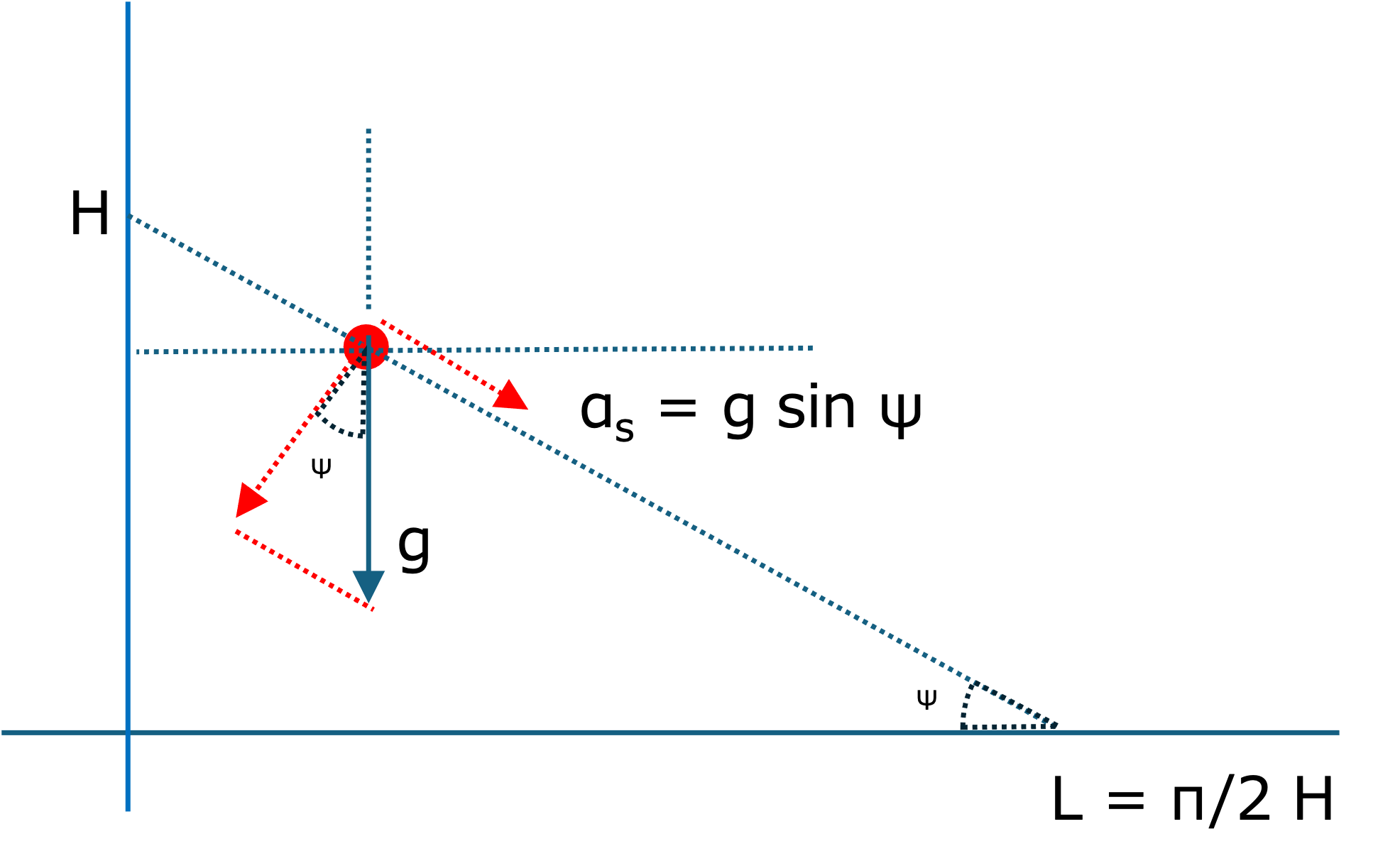
高さH,距離L=π/2 H,を考えればいいので,
$$
{ \Large \displaystyle
\begin{equation}
\begin{split}
tan \ \psi &= \frac{H}{L} = \frac{2}{\pi} \\
\alpha_{s} &= g \ sin \ \psi = g \ \frac{H}{\sqrt{H^2 + (\frac{ \pi}{2} H})^2} \\
&= g \frac{1}{\sqrt{1 + \frac{\pi^2}{4}}} = g \frac{1}{\sqrt{ \frac{4 + \pi^2}{4}}}= g \frac{2}{\sqrt{ 4 + \pi^2}}
\end{split}
\end{equation}
}
$$
斜面方向の速度,変位は,
$$
{ \Large \displaystyle
\begin{equation}
\begin{split}
\alpha_{s} &= g \frac{2}{\sqrt{ 4 + \pi^2}} \\
v_s(t) &= \alpha_2 \ t \\
s(t) &= \frac{1}{2} \alpha_s \ t^2 \\
\end{split}
\end{equation}
}
$$
xy方向の変位は,
$$
{ \Large \displaystyle
\begin{equation}
\begin{split}
x_s(t) &= s(t) \ cos \ \psi \\
y_s(t) &= H - s(t) \ sin \ \psi \\
\end{split}
\end{equation}
}
$$
到達時間は,
$$
{ \Large \displaystyle
\begin{equation}
\begin{split}
y_s(t) &= H - s(t) \ sin \ \psi = 0 \\
H &= \frac{1}{2} g \frac{2}{\sqrt{ 4 + \pi^2}} \ t^2 sin \ \psi \\
&= \frac{1}{2} g \frac{2}{\sqrt{ 4 + \pi^2}} \ t^2 \frac{2}{\sqrt{ 4 + \pi^2}} \\
&= g \frac{2}{ 4 + \pi^2} \ t^2 \\
t &= \sqrt{\frac{H(4 + \pi^2)}{2g}}
\end{split}
\end{equation}
}
$$
となります.
先程の式に代入しても,
$$
{ \Large \displaystyle
\begin{equation}
\begin{split}
t &= \sqrt{\frac{2H}{g }}\frac{1}{ sin \psi}\\
tan \ \psi &= \frac{H}{L} = \frac{1}{\pi/2}\\
sin \ \psi &= \frac{1}{\sqrt{1+ ( \pi/2)^2}} \\
t &= \sqrt{\frac{2H}{g }} \sqrt{1+ ( \pi/2)^2}= \sqrt{\frac{2H}{g }} \sqrt{\frac{4 + \pi^2}{4}} = \sqrt{\frac{H(4 + \pi^2)}{2g}}\\
\end{split}
\end{equation}
}
$$
と一致します.
$ { \Large \displaystyle H = 1 m, g = 9.8 m/s^2 }$,とすると,
直線では,
$$
{ \Large \displaystyle
\begin{equation}
\begin{split}
t &= \sqrt{\frac{H(4 + \pi^2)}{2g}} \\
&= \sqrt{\frac{1 \times (4 + \pi^2)}{2 \times 9.8}} \\
&= 0.84 s
\end{split}
\end{equation}
}
$$
サイクロイド曲線では,
$$
{ \Large \displaystyle
\begin{equation}
\begin{split}
T &=
\sqrt{\frac{H}{2g}}\ \pi \\
&= \sqrt{\frac{1}{2 \times 9.8}}\ \pi = 0.7096 \ s\\
\end{split}
\end{equation}
}
$$
と,サイクロイド曲線を進むほうが早く進むことになります.
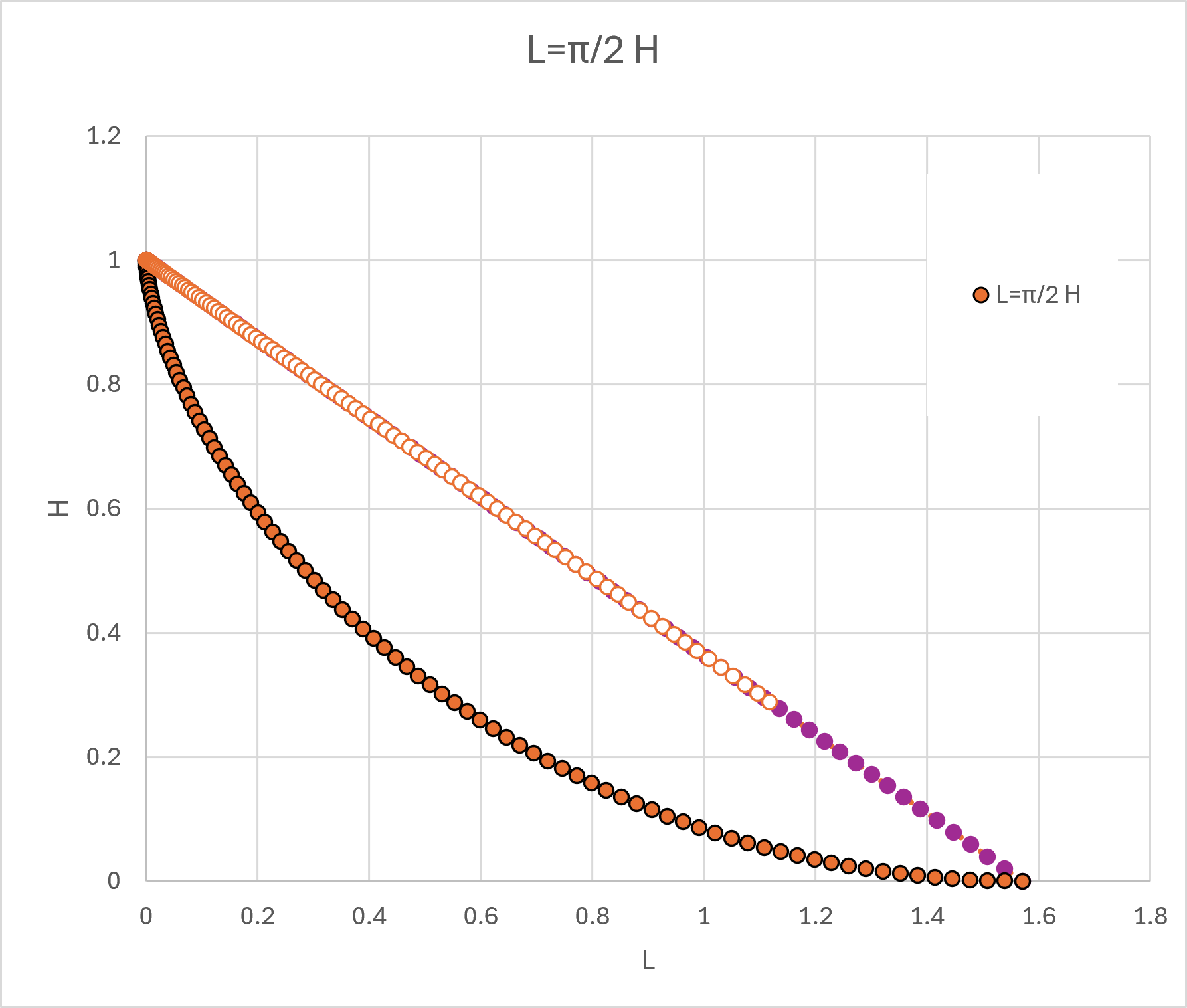
動画も作りましたので,ここ,からどうぞ.
次ページは,最終的に水平になる場合の曲線に沿った移動距離,を考えていきます.


